News:

SMF - Just Installed!

Main Menu
SNES W-Z

WWF Raw

By Sculptured Software/LJN
screenshot
Original RVG screenshot

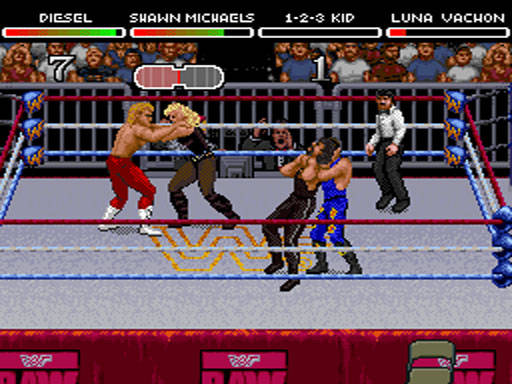
In 1994 LJN published WWF Raw, based on the popular wrestling program Monday Night Raw. The follow-up to WWF Royal Rumble, Raw features an updated roster and more game options. With respect to the gameplay, both games are nearly identical. Slams and strikes are still executed using the A and B buttons, but each wrestler now has an additional finishing move in his or her arsenal called a mega move. Mega moves are performed by inputting special button combinations, and lead to some ridiculous situations like Doink the Clown getting a running start and punting an opponent out of the ring. I would say that the extra moves add another element of strategy to the bout, but they’re far too situational to be useful. You’ll probably find yourself ignoring them after some time. That’s O.K., for where the game really stands apart from its predecessor is the number of game modes. Not only can you have your standard match with pinfalls, but LJN has added the Royal Rumble and Survivor Series (elimination tag match) modes to the fray, and the new tornado tag mode is excellent for two players who just want to get to the meat of the game. As with WWF Royal Rumble, the music and sound effects are well done: body slams, the thudding of fists, and even the ropes sound authentic. It’s really a fine wrestling game for 1994, and was one of the WWF’s best console games during the 16-bit era. It was an improvement over its predecessor in every way except for the roster, which is where I feel Royal Rumble has the advantage. You’re essentially trading Ric Flair, Randy Savage, and Ted DiBiase for Doink, Luna Vachon, and 1-2-3 Kid. Other than that, it’s a tremendous effort and a solid, fun wrestling game.

Reviewed bywyldephang
RVG rating8/10
SNES W-Z

WWF Royal Rumble

By Sculptured Software/LJN
screenshot
Original RVG screenshot

The WWF inaugurated its Royal Rumble series in 1988. Modeled on the battle royale match, Royal Rumble is a contest in which a large group of wrestlers fight to stay inside the ring and the last one left standing is declared the winner. The concept makes for matches that are absolutely out of control with wrestlers double-crossing each other in a din of powerslams, manly grunts, and crashing turnbuckles. It would appear tailor-made for a video game, where action is the main selling point, but it wasn’t until WWF Royal Rumble for the Super Nintendo was released in 1993 that console gamers would have a chance to relive their favorite Rumbles. A sequel to the mostly drab WWF Super WrestleMania, Royal Rumble addresses almost all of the mistakes of its predecessor. While the SNES version of Super WrestleMania lacked finishing moves, Royal Rumble features finishers for each of the twelve wrestlers on the roster, which includes icons like Bret Hart, The Undertaker, and Yokozuna. The character models are more detailed, and the sound effects and music have received a complete overhaul. The result is a game that is easy to pick up and play, and presents a wrestling experience that is surprisingly faithful to the actual product. The game mechanics are easy to grasp. You strike your opponent with the A and B buttons, and when you initiate a tie-up, you execute slams with the face buttons. When your opponent’s health is low, you can end the match emphatically by pulling off a finishing move. In addition to the standard one-on-one match, the Royal Rumble and tag team modes support two players for added fun. WWF Royal Rumble was a major step forward for LJN and is easily one of the best wrestling games on the console.

Reviewed bywyldephang
RVG rating8/10
SNES W-Z

WWF WrestleMania: The Arcade Game

By Sculptured Software/Acclaim
screenshot
Original RVG screenshot

Though wrestling is a larger-than-life spectacle, I’ve always admired the games that try to capture what it’s like to be in the wrestling ring. The previous two WWF games on the Super Nintendo—Raw and Royal Rumble—represented what wrestling was truly about. Matches build and climax in a sensible fashion, the moves are animated to look like what they’re supposed to represent, and the presentation takes the minimalist approach of having very few stat bars and counters that distract you from the wrestling ring. WrestleMania: The Arcade game is the antithesis of this concept. More of a fighting game than wrestling, the digitized presentation will remind you of Mortal Kombat, as will the over-the-top special moves involving lightning bolts and fireballs. (As Hulk Hogan infamously proved at Halloween Havoc 1998, wrestlers should never be trusted with fire.) It’s clear that Acclaim was pushing for a more arcade-like product and the results are fairly mediocre as this wrestling-fighting hybrid is neither a decent wrestling game nor a competent fighter. To counterbalance the awkwardness of fighting in a wrestling ring, where you can move vertically, most special moves awkwardly “snap” onto your opponent. In a handicap match, it’s not uncommon to fly past your intended target with a drop kick and sock the poor, unsuspecting S.O.B. on the other side of the ring. The object is to deplete your opponent’s energy, so button-mashing and projectile spamming will probably be the extent of your fun. The Super Nintendo version features two fewer wrestlers than the other ports, and while the Genesis version supports four characters on the screen at once, you’ll make do with three on the SNES. Not that it matters; the best way to avoid a train wreck is to stay off the tracks. I don’t recommend this one.

Reviewed bywyldephang
RVG rating6/10