
N64 A-C

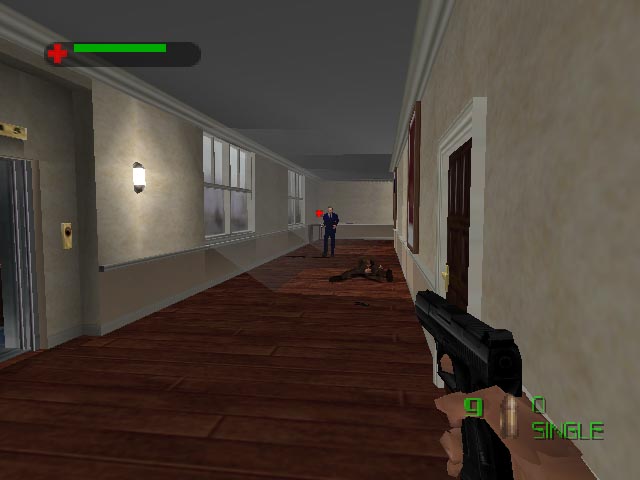
007: The World Is Not Enough
By Eurocom / EA Games
screenshot
Original RVG screenshot

When the 007 license changed hands in 1999, few expected EA’s debut effort on the Nintendo 64 would topple GoldenEye 007. After Tomorrow Never Dies for the PlayStation was released to lukewarm critical reception, EA knew they’d need to return to the basics if they wanted to knock GoldenEye off the mantle. And apparently, they learned their lesson. 007: The World Is Not Enough does borrow heavily from its predecessor, and even improves upon it in several ways. The engine has been rebuilt from the ground up and now features a larger selection of weapons and items. Some weapons and gadgets have more than one fire mode, increasing the utility of Bond’s inventory by a significant margin. The campaign still consists of objective-based missions, and each successive difficulty level stacks on additional challenges for you to complete. The missions are generally good, but some of them lack depth, and others try for too much depth, like a poorly implemented underwater stage. To save your progress, you’ll need a Controller Pak, but I can’t help thinking a battery save option would’ve been more convenient. The graphics engine has been improved and puts the Expansion Pak to good use. Even on “High Color” mode, the controls feel responsive and framerate stays consistent. No comparison to GoldenEye would be complete without some reference to the multiplayer. It makes a nice return in TWINE with a few added modes, such as Capture the Briefcase, and the ability to add bots into the game. The multiplayer is good as a whole, but it doesn’t quite have the speed of its predecessor. Other than that, I can’t find many negative things to say about TWINE. I feel it’s been condemned to obscurity simply because it’s not GoldenEye, but as a standalone game, it’s worth a playthrough.

Reviewed bywyldephang
RVG rating8/10
N64 A-C

1080 Snowboarding

By Nintendo
screenshot
Original RVG screenshot

1080 Snowboarding hit shelves just after the 1998 Winter Olympics wrapped up, when winter sports were still fresh on our minds. It was one of the first games to offer an authentic snowboarding experience, with all the bumps and bruises that come with a day at the slopes. In 1080, you can choose from up to five initial characters, each with their own attributes and trick sets. Every character comes with eight boards you can select from depending on your situation. If you’re participating in a race, you’ll want a board with tight handling and good acceleration, and if you’re entering a trick contest, you might want something different. The game modes include trick attack, where you perform daring aerial stunts for high scores, and match race, where you compete against another contestant in a race to the finish line. While the racing feature isn’t particularly groundbreaking, the trick attack is one of the first of its kind to let you perform dazzling snowboarding tricks like nose grabs and 360s. All of the tricks are mapped out to the B and R buttons, making it easy to pull off some spectacular moves. The graphics and overall feel of the game are to the best of my knowledge authentic to the sport. You’ll bounce and bob down slopes and bank turns while trying to keep your balance. This aspect of 1080 can be quite challenging, especially because the computer always executes the perfect route through every course. The gameplay and level design are cool, but after some time, you might grow tired of racing the same six courses. Indeed, one shortcoming of 1080 is that it doesn’t offer terribly much in the way of variety. But for a quick race now and then, you can’t go wrong with 1080.

Reviewed bywyldephang
RVG rating7/10
N64 A-C

Banjo-Kazooie

By Rare / Nintendo
screenshot
Original RVG screenshot

Banjo-Kazooie was dubbed Rare’s “Mario killer” for the fact that it proposed to do everything Super Mario 64 could do, but better. In many ways, Banjo-Kazooie does just that: the worlds are larger and more involved, the textures more detailed, and the gameplay has just as much depth. There’s no doubting that Banjo-Kazooie is a jewel of the Nintendo 64, and it’s about as good as 3D platformers come. A simple country bear, Banjo, is on a mission to rescue his sister from the evil witch Gruntilda. It’s a rough world, full of hazards and Gruntilda’s baddies, but a country bear can survive. Banjo can perform rolls and high jumps, and his avian sidekick Kazooie shoots eggs and can learn other abilities like the Talon Trot to increase the pair’s maneuverability. There are nine levels, each with a set number of collectibles and objectives, and you are awarded puzzle pieces (Jiggies) for meeting goals. To open up new levels, you must collect Jiggies and find the corresponding portals in Gruntilda’s Lair, which acts as a central hub. The levels are all well designed and interesting: you’ll visit beaches, swamps, mountains, and deserts. You’ll even scale a giant tree, and you really start to appreciate how Banjo-Kazooie pushes the capabilities of the hardware when you’re looking down from above. The game draws elaborate worlds without sacrificing performance: the framerate is consistent, the controls smooth and responsive. Occasionally, the camera angles will go rogue and lead to accidental deaths, but that’s typical for any 3D platformer, even the almighty Super Mario 64. Which brings us back to the question: is this the “Mario killer?” I actually believe they complete each other. Where Banjo-Kazooie is an open-world adventure, Super Mario 64 is more of an adrenaline rush. No collection is complete without both.

Reviewed bywyldephang
RVG rating9/10
N64 A-C

Bio F.R.E.A.K.S.

By Saffire / Midway
screenshot
Original RVG screenshot

It’s frustrating when a game promises so much in concept only to fall short in the execution. Bio F.R.E.A.K.S. certainly has all the makings of a great 3D fighter, with interactive arenas, robust move sets, and free range of movement. All characters are equipped with a jetpack that enables them to fly around the arenas, and they’ve even got the ability to land a fight-ending fatality at any point in the match. Bio F.R.E.A.K.S. weaves a veritable tapestry of gore, and one of the major selling points of the game is the ability to dismember your opponents in mid-battle with powerful attacks. Not only is the visual effect cool, but it affects gameplay: if you lose a limb, your character won’t be able to perform certain moves. It can change the whole dynamic of a fight. You can perform ranged attacks with the A button, opening up the arena for long-range combat in a way that is rather unique to Bio F.R.E.A.K.S. All of these individual elements are well designed, but when mixed together, they just don’t cohere. Aerial movement is too sensitive, for instance, and because the camera angle is locked to the side, movement on the z-axis is disorienting—it’s too easy to simply fall into a pit of lava because you misjudged the trajectory of your landing. Gameplay generally degenerates into two categories: cat-and-mouse aerial chases around oversized arenas, or button-mashers in close quarters with almost no strategy. It seems the developers were distracted by balancing too many innovations at one time and lost sight of the overall product. Bio F.R.E.A.K.S. is one of those games that proposes to revolutionize the way you play video games, but due to unbalanced game mechanics, the effort comes off looking scattered and unpolished.

Reviewed bywyldephang
RVG rating6/10
N64 A-C

Blast Corps

By Rare / Nintendo
screenshot
Original RVG screenshot

Video games let you act out a lot of different fantasies. Some will have you speeding down racetracks, and others will put you in the cockpit of a starfighter. The possibilities go on and on, so it’s astounding that so few developers have tapped into what is surely a common fantasy for a lot of people: demolition. In Blast Corps, demolition is the name of the game as you climb into bulldozers and level everything in your way for points. It’s a simple concept, but it’ll keep you busy for hours, especially considering the variety of vehicles at your disposal. The goal of each stage is to clear out a path for a transportation vehicle carrying a nuclear missile. If the missile so much as touches a stray object . . . bang! Straight to the moon! After you’ve cleared the way, you can drive around the level looking for additional structures to destroy, and you’ll earn a gold medal if you raze 100 percent of the map. As you progress through the game, you’ll gain access to a plethora of interesting demolition vehicles. You begin with typical bulldozers, but you’ll eventually have a chance to pilot an armored mech suit equipped with a jetpack. The additional vehicles will come in handy as the missions become more complex and start to integrate puzzle elements, like pushing dynamite into place. If your appetite for destruction hasn’t been satisfied by the end of the game, you can run through the levels in time trial mode, unlocking exotic new locations as you go. Blast Corps is a game with a simple premise, but one that it executes very well. Overall, the generous learning curve and addicting gameplay should have you coming back to this one frequently.

Reviewed bywyldephang
RVG rating8/10
N64 A-C

Bomberman Hero

By Hudson Soft / Nintendo
screenshot
Original RVG screenshot

By the mid-‘90s, every video game icon from Mario to Mega Man had its own 3D adventure game, so it was only natural for Bomberman to get the same treatment. Bomberman Hero was not the first game in the series to be released on the Nintendo 64, but it was the one that perhaps made the shakiest transition to the 3D realm. For starters, when you think of Bomberman, you think of its distinct gameplay in which you move along a grid and plant bombs to trap and defeat your enemies; it’s a simple but effective concept and always leads to very chaotic back-and-forth matches. Unfortunately, Bomberman Hero does away with all the best gameplay elements of the Bomberman series, and the result is a fairly mediocre action-platformer that fails to stand apart from the surplus of other platforming games in its time. The goal is to progress through a series of linear stages, defeating enemies and avoiding hazards en route to the exit. Most of the enemies look like they never left the drawing board: they have predictable attack patterns and pose little threat. Hudson attempts to break up the monotony with the occasional flying or underwater stage, but the controls feel counterintuitive and aiming is more cumbersome than it should be. Make it through all the stages and you’ll fight a boss at the end of each area, but the boss fights are usually tedious and suffer from poor design and inconsistent camera angles. The characters have that crude early polygonal look, yet the game came out in 1998, the same year The Legend of Zelda: Ocarina of Time graced shelves. The soundtrack, on the other hand, is actually quite competent and accentuates the stylish space-age motif. Beyond that, you’re not left with much. Stick with the originals.

Reviewed bywyldephang
RVG rating5/10
N64 A-C

Cruis’n USA

By Williams / Nintendo
screenshot
Original RVG screenshot

A port of the popular 1994 arcade racer by Midway, Cruis’n USA for the Nintendo 64 lets you take the racing action into your home with seven playable hot-rods and fourteen tracks based on landscapes from around the United States. If you’ve ever wanted to tear through the Iowa countryside in a souped-up luxury car, or tour the Arizona desert in a Ferrari, Cruis’n USA delivers the goods. Most of the tracks are reminiscent, albeit not perfect facsimiles, of the states and landmarks they’re intended to represent, and it goes without saying that no two tracks look alike, and there’s always some variety in the backgrounds and track designs. The issue is that, outside of these superficial differences, there isn’t a lot to distinguish one location from the other, and so, the variations in scenery have little functional influence on the gameplay. This is the area where Cruis’n USA is most likely to fall short of your expectations. While the individual races themselves are fun, the Cruise the USA mode seems more tedious than it was probably planned to be. After a while, the tracks begin to blend together and the game fails to offer anything new as you get ten or twenty minutes into the circuit. The car selection could’ve been expanded, too, and there could’ve been more effort spent in ensuring that each vehicle was programmed with unique handling and acceleration properties. Every car handles the same way: overly sensitive and awkward. If there had been some practical differences among the cars and tracks, there’s no question that Cruis’n USA would’ve been one of the console’s better racing games because the concept is surely interesting. As it stands, it’s one those games that is best enjoyed in short bursts, but not recommended for longer gaming sessions.

Reviewed bywyldephang
RVG rating6/10