Hexen
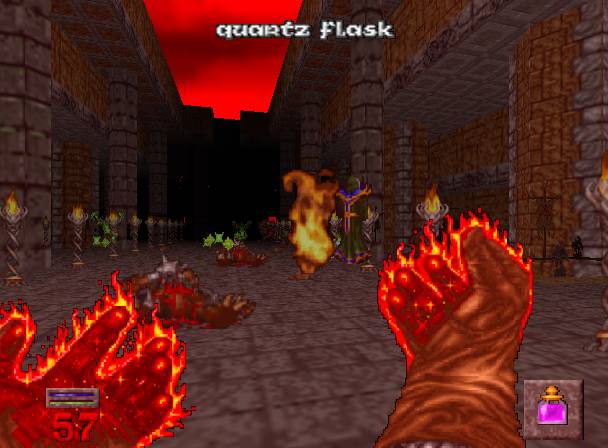
Riding on the coattails of Doom’s success in 1993, the world of PC gaming entered an FPS craze as a deluge of imitations called “Doom clones” began to hit the market. id Software’s Hexen, released in 1995, came into existence at the height of the Doom vogue and just before the genre entered its 3D polygonal phase. As such, the engine is mostly reminiscent of Doom, though it has been modified to allow jumping, teleportation between worlds, and a basic inventory system. The inventory has been carried over from 1994’s Heretic, but the ability to travel between dimensions is a new concept and forms the core of Hexen’s gameplay. Essentially, you must use the portals to access various locations and dungeons, collecting key items that help you progress through the quest. There’s a great deal of open-world exploration involved. You might find a door in the second level that cannot be unlocked until you flip a switch in the fourth or fifth, or you might come across a key item that requires you to solve puzzles across multiple locations. It’s a great idea, but most of the puzzles feel very disconnected, and the lack of true in-game narrative means that most of these puzzles will appear to exist without purpose. You control one of three character classes, the Fighter, Cleric, and Mage, each of which are distinguished from the others by their weapons, speed, and attack power. The Nintendo 64 version suffers from a poorly designed control scheme and heavily pixelated graphics. It does support local co-op, and given the open-world nature of the game, it can be fun to work together to solve puzzles. But as a whole, the game underperforms more than it really should, and you’re bound to have only so much fun before it gets tedious.