
N64 O-R

Paper Mario

By Intelligent Systems / Nintendo
screenshot
Original RVG screenshot

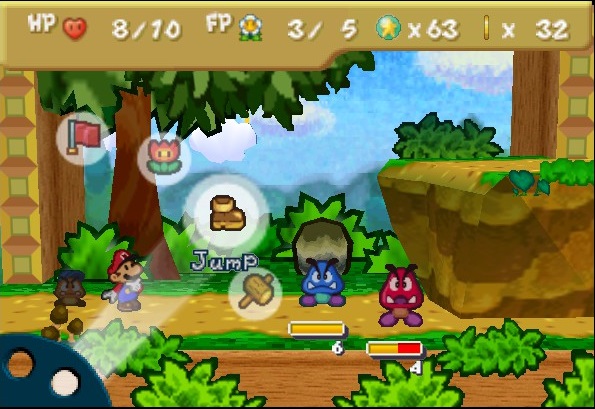
When I think of all the great RPGs across the 32/64-bit generation, it’s a shame so few of them belonged to the Nintendo 64. After Square defected to Sony in 1996, Nintendo was left without its primary RPG studio, and thus began a veritable dark age for Nintendo RPGs—that is, until Paper Mario was released in 2000. In many ways, Paper Mario might be considered a spiritual successor to Square’s SNES classic Super Mario RPG. But Paper Mario really emphasizes the platforming elements to the point that level design and interactivity become a significant part of the gameplay. You control Mario, who is on a mission to rescue Princess Peach from Bowser and restore the Star Rod to its rightful owners, the Star Spirits. The Star Rod grants immense power, but Bowser stole it and you must trek through castles, caves, and dungeons to get it back. Enemies are scattered throughout the stages, and if you run into them, you initiate a turn-based battle. You won’t find Square’s Active Time Battle system here. The battle mechanic is pared down to its most basic level, but it works well. On Mario’s turn, you can select from a number of battle commands, special abilities, and items, and you can increase the effectiveness of your actions by timing your button presses correctly. Throughout the game, Mario will enlist the help of partners who can perform various commands in battle and assist with platforming segments. All of the characters and levels are designed well and it’s a lot of fun to explore new areas, speak with townspeople, and complete side-quests. The only disappointment is the game’s difficulty: it’s almost too easy. That notwithstanding, there’s a surprising amount of depth to Paper Mario. It’s highly recommended for RPG veterans and newcomers alike.

Reviewed bywyldephang
RVG rating9/10
N64 O-R

Perfect Dark

By Rare
screenshot
Original RVG screenshot

Often considered the spiritual successor to GoldenEye 007, Perfect Dark takes Rare’s acclaimed FPS formula and expands it in every way possible. Having lost the 007 license to EA, Rare fires back with a secret agent of their own: Joanna Dark, a member of the Carrington Institute and lethal saboteur. What starts as a simple extraction mission for Joanna eventually develops into a desperate race to rescue the President of the United States, and along the way, she uncovers a corporate conspiracy, encounters a hostile race of aliens, and befriends an assortment of quirky characters. It’s an eccentric, yet highly entertaining storyline. GoldenEye’s objective-based mission structure returns in Perfect Dark, and you can still change the complexity of the missions by adjusting the difficulty setting. You can now play these missions with a friend in co-op split-screen mode, which is a nice addition. If you’re more in the mood for four-player deathmatch, then Perfect Dark is just as capable as GoldenEye at delivering a wild multiplayer experience. You can program bots to enter the match and serve as cannon fodder or finely tuned assassins, depending on their intelligence level. The multiplayer levels are designed to keep your matches action-packed, and the weapons are among the most creative in video game history, including the instant classic Laptop Gun, which can be deployed as an automated defense turret. Almost every weapon has a secondary fire mode, allowing you to get the most out of your inventory in single- and multiplayer modes. To experience all of Perfect Dark, you’ll need the Expansion Pak, which enables high resolution textures and allows you to play the single-player missions. Perfect Dark surely lives up to its name: it’s the perfect FPS game on the Nintendo 64 and a worthy successor to GoldenEye.

Reviewed bywyldephang
RVG rating10/10
N64 O-R

Pilotwings 64

By Paradigm Simulation / Nintendo
screenshot
Original RVG screenshot

Pilotwings has a long history of showcasing the technical might of new Nintendo consoles. On the Super Nintendo, Pilotwings served as a tech demo for Mode 7 effects. Working with a newly designed 3D engine, Nintendo then brought out Pilotwings 64 as a launch title for the Nintendo 64 to give fans a glimpse at the capabilities of the hardware. It turns out their grand showing was a success: Pilotwings 64 is gorgeous, and you’ll feel a sense of wonder as you soar 150 feet above sea level and survey the ground below from atop the clouds. Pilotwings 64 brings back some old events from the Super Nintendo title, like the airplane and skydiving, and introduces some new ones, including the addictively relaxing Birdman mode, where you simply explore the island at your leisure. This was the first game in the series that slackened the leash, so to speak, as you have an entire island at your disposal and you’re not particularly limited in how you can explore it. It is designed to be a miniature of the United States, so you’ll come across some familiar sights in your travels, like a Mount Rushmore with Mario’s face chiseled in stone right beside Thomas Jefferson. The event modes have you completing objectives, flying through rings, or landing on targets, and there’s enough variety among the events and the levels to keep the gameplay fresh. There’s also the added incentive to unlock more bonus events by earning gold medals. Strangely enough, Pilotwings 64 features nothing in the way of multiplayer modes. With all these vehicles, I can’t help thinking there could’ve been a use for a two-player race or high score contest. But as a single-player game, Pilotwings 64 packs a ton of content. It’s essential for any Nintendo 64 collector’s library.

Reviewed bywyldephang
RVG rating8/10
N64 O-R

Quake

By Midway / GT Interactive
screenshot
Original RVG screenshot

The original Quake for the PC ushered in a new era of online gaming. It was one of the first games to really embrace the online gamer community with a totally customizable multiplayer experience, and it spawned the game engine upon which all modern FPS games would be based. But if you strip away everything that made the multiplayer experience amazing, you’re still left with a memorable single-player campaign. Quake was designed with a striking Gothic art style that’s very ominous, yet appropriate for the subject matter. Humanity has been experimenting with a technology known as the Slipgate, which facilitates interdimensional travel. A mysterious evil on the other side of the portal has come through with hordes of monsters and it’s all up to you to stop them. The gameplay is so good as to be legendary: the physics engine allows you to run and jump freely about the world, interact with environments, and engage your enemies with total control. You’ll lob grenades at undead foes and tussle with chainsaw-toting ogres. Quake established such a cult following that it was only natural for the Nintendo 64 to get its own port. So, how does it hold up? Most of the gameplay elements are kept intact; it runs at a consistent framerate and feels responsive enough. But this comes at a cost: the character models look blurry and the animations are missing frames. The number of levels has been decreased from 32 to 25, and the iconic introductory “Welcome to Quake” hub was removed. However, you can still expect the larger-than-life boss encounters. There is an option for two-player deathmatch, but the lag makes the split-screen mode very difficult to enjoy. Overall, it’s far from a perfect port, but it’s playable and worth a try.

Reviewed bywyldephang
RVG rating7/10
N64 O-R

Quake II

By Raster Productions / Activision
screenshot
Original RVG screenshot

In December 1997, id Software released the anticipated sequel to Quake, and just like that, the Quake mythos changed from Gothic horror to science fiction. Indeed, Quake II was Quake in name only: there aren’t a lot of common elements between the two games, but time has proven to be much friendlier to Quake II in terms of continuing its plot elements. Quake II introduces the Strogg, a barbarous alien species bent on conquering earth. They’re not nice to deal with: they’re cruel to their captives and offer no mercy. Your mission is to infiltrate the Strogg HQ and disable the command core. You’re alone, but you’ll find an adequate amount of firepower to tilt the odds in your favor, from standard-issue machineguns and shotguns to experimental rail cannons which atomize enemies on impact. The enemies are a varied lot and include everything from grunts to heavily armored cyborgs. The Nintendo 64 port features fewer levels than the PC version—there are nineteen short, objective-based linear stages—but by far the biggest pitfall is the performance. Where the PC game is responsive and fast, the Nintendo 64 port creeps along at an agonizingly slow pace as the animations are choppy and the controls feel sluggish. Quake II has what the Nintendo 64 port of Quake lacked, which is a four-player deathmatch mode, but subjecting your Nintendo 64 to that kind of strain is just inhumane: even with the Expansion Pak, the console lags behind. I would say that Quake II is a good example of a game that pushes the Nintendo 64 beyond its limits, but the PlayStation port manages smoother gameplay with less RAM. The Nintendo 64 version has the nicer textures and lighting effects, but ultimately you sacrifice too much in the gameplay to balance it out.

Reviewed bywyldephang
RVG rating6/10
N64 O-R

Resident Evil 2

By Capcom
screenshot
Original RVG screenshot

Capcom’s flagship survival horror series Resident Evil debuted on the PlayStation in 1996. The highly anticipated sequel was released in 1998 to critical acclaim and subsequently ported to the Dreamcast, PC, and believe it or not, the Nintendo 64. Who would’ve thought a game with extensive FMV sequences and voiceovers would be a candidate for a Nintendo 64 adaptation? Apparently Capcom did, and their effort is nothing short of incredible as they managed to squash down two discs of content onto one bulky 64 MB cartridge while preserving all the cinematic sequences of the original version. In Resident Evil 2, you’re dropped into a city overtaken by a viral outbreak which has transformed the residents into flesh-eating zombies. You assume the role of either Leon or Claire and begin a harrowing race to locate survivors and escape the city. Along the way, you’ll solve puzzles and fight some gruesome monsters. Ammo and health are limited, so you’ll have to learn when to dodge an enemy and when to neutralize one. It can be difficult: it takes some time to get used to the “tank” controls, but it’s smooth sailing once you do. After you finish one character’s story, you open up a corresponding file for the second one. You won’t uncover the entire plot unless you complete both scenarios, so there’s definite replay value. The Nintendo 64 port features enhanced textures, bonus costumes, and a new control scheme that takes advantage of the analog stick. Understandably, a few cutbacks needed to be made: the voiceovers are somewhat muffled, and the FMV sequences are heavily compressed and resemble the 144p setting on YouTube. Otherwise, this is as good a version of Capcom’s survival horror classic as you’ll find, so get your copy today and relive the horror like it’s 1998!

Reviewed bywyldephang
RVG rating9/10
N64 O-R

Rocket: Robot on Wheels

By Sucker Punch/Ubisoft
screenshot
Original RVG screenshot

Though Sucker Punch would come to be known for teaming up with Sony and creating top-rate games like Sly Cooper and Infamous, they got off to an auspicious start on the Nintendo 64 with Rocket: Robot on Wheels, a 3D platformer featuring a little robot on a mission to restore order to a theme park gone berserk. The goal of the game is to collect tickets to unlock new levels, and tokens to unlock new abilities, and work your way through six stages en route to an encounter with raccoon Jojo, the orchestrator of all the madness. The stages feature the kinds of attractions you’d see at theme parks, from mine carts to animatronic dinosaurs. You’ll even build your own roller coaster and take it for a spin. Most of the puzzles involve moving or stacking objects with Rocket’s tractor beam, which doubles as a grappling hook for tricky jumping segments. The controls are fast and responsive, and the gameplay is fluid, but I have some serious difficulties with the camera. Adjusting the camera can be a common nuisance in 3D platforming games, but never more so than in Rocket. Too many times, you’ll be winding your way through a tunnel or cave and the camera will inexplicably lock itself into the worst angle possible. 3D platformers are challenging enough on their own, but it’s even worse when you can’t see where you’re going. If it weren’t for the exceptional gameplay and the ability of the game to draw astonishing levels without the slightest hiccup in framerate, the dysfunctional camera system, which is among the worst I’ve ever seen on the Nintendo 64, would almost ruin the experience entirely. However, Rocket has a lot going for it, and despite some execution flaws, it’s still incredibly fun to play.

Reviewed bywyldephang
RVG rating8/10